The Boardroom's Blind Spot: Why Your QA Team Can't Save You From Your Own Product Decisions
A satirical examination of how executive-level product pivots systematically undermine even the most sophisticated QA processes—and why your competitors' slower releases might be crushing your market share.
The Monday Morning Massacre
It's 9:47 AM on Monday. Your QA team just finished a two-week sprint testing the new checkout flow. Test coverage is at 94%. Automated regression suites are green. Manual exploratory testing uncovered and fixed six edge cases. The feature is ready to ship on Wednesday.
Then you get the Slack message: "Quick sync at 10? CEO wants to add social login before launch. Should be simple, right?"
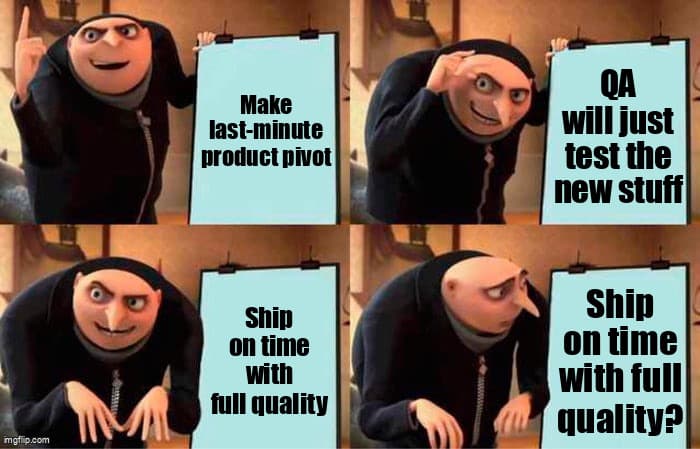
By 10:15, you're in a conference room watching two weeks of quality work evaporate. The "simple" addition requires OAuth integration, user migration logic, session management refactoring, and changes to every authentication touchpoint. Launch is still Wednesday. "QA can just focus on the new stuff," someone suggests, as if the rest of the system exists in a vacuum.
Welcome to the boardroom's blind spot—where strategic pivots happen in minutes and quality consequences unfold over months.
The Real Cost of "Strategic Agility"
Let's talk numbers, because that's the language executives understand. When you make a last-minute product pivot:
- Technical debt multiplier: 10x. A feature that would take 5 days to build properly and test takes 2 days to hack together and 48 days to fix over the next year (defects, patches, refactoring, support tickets).
- QA effectiveness drops by 60%. When testing time is compressed, you lose deep exploratory testing, cross-browser verification, performance testing, and accessibility audits. You keep the smoke tests and call it good.
- Engineer productivity crater: 40% for 3 sprints. Context switching, technical debt, and "what broke this time?" debugging sessions compound quarter after quarter.
- Customer churn acceleration: 2-3x normal rate. Users who encounter bugs in new features are twice as likely to abandon as users who encounter bugs in stable features. You just told them you're unreliable at the exact moment they were trying something new.
The math is brutal: rushing a feature to "win" a two-week market advantage costs you three months of productivity and a customer confidence hit that takes six months to repair.
Why Your Competitors Are Beating You By Going Slower
Here's the uncomfortable truth: that competitor who ships half as many features as you is probably capturing more market share. Why?
Reliability is a feature. Users remember the app that works more than the app with the most buttons. When your competitor ships a payment flow, it works in Safari, handles international credit cards, and doesn't mysteriously fail on Tuesdays. When you ship, you're still fixing edge cases three weeks later while your support team deflects angry tweets.
Engineering velocity is cumulative. Their engineers spend 80% of time building new things and 20% fixing old things. Your engineers spend 40% building, 40% debugging, and 20% in "emergency" meetings about why this week's release broke last month's feature. Guess who's shipping faster six months from now?
Quality compounds. Every solid release builds trust—with users, with engineers, with investors. Every buggy release erodes it. After a year, they're announcing features to enthusiastic users while you're announcing features to skeptical users who remember the last three times you overpromised.
The Safety Net Fallacy
Most executives think of QA like this: "We build the product, then QA makes sure it works." It's the safety net model—engineers are the trapeze artists, QA catches them if they fall.
This is catastrophically wrong.
QA isn't a safety net. QA is your product partner who tells you which stunts are survivable and which ones end with someone in a full-body cast. When you exclude QA from design decisions, you're essentially saying: "We'll figure out if this is possible after we've promised it to customers and allocated the budget."
Here's what actually happens when QA is a partner, not a checkpoint:
- Testability gets designed in. Features are architected to be verifiable. Edge cases are identified before code is written. Dependencies are minimized.
- Quality gates are meaningful. When QA says "this isn't ready," it's not because they need more time—it's because the product genuinely isn't ready and shipping would be a strategic mistake.
- Risk is quantified. Instead of "Can we ship Friday?" conversations happening in a vacuum, QA provides data: "We can ship Friday with known issues in X, Y, Z, affecting approximately N% of users in these scenarios."
- Scope is negotiable before commitment. When engineering says a feature will take 3 weeks, QA helps the executive team understand which parts of those 3 weeks are negotiable (polish, edge cases) and which aren't (core functionality, data integrity).
Calculate the Real ROI of Quality
Let's make this concrete with a simple framework you can use in your next product planning meeting:
Feature Urgency Score (0-10): How urgent is this feature really? Is it a competitive threat (9), a strategic differentiator (7), or "nice to have" (3)?
Quality Impact Score (0-10): How much does cutting corners hurt? Core payment flow (10), user profile page (5), admin dashboard styling (2)?
Technical Debt Multiplier: How much will rushing this feature cost us over the next 6 months? Simple calculation: (Engineering time saved now) × (Technical debt multiplier).
The Decision Matrix:
- High Urgency + Low Quality Impact: Rush it. Ship Friday. (Example: Marketing landing page for a conference next week)
- High Urgency + High Quality Impact: Cut scope, not quality. Ship a perfect version of 60% of the feature. (Example: Checkout flow needed for Black Friday—ship credit cards perfectly, add PayPal later)
- Low Urgency + High Quality Impact: Do it right. This is infrastructure. (Example: User authentication, data migration, payment processing)
- Low Urgency + Low Quality Impact: Delay or kill. This is distraction. (Example: That dashboard widget three people asked for)
The key insight: urgency doesn't override quality impact. A truly urgent feature with high quality impact should trigger a scope cut, not a quality cut.
What "Ship It" Culture Actually Costs You
"Move fast and break things" is a great philosophy if you're a social network in 2009 with no revenue and infinite VC runway. You're not. You have paying customers, competition, and a reputation.
Here's what "just ship it" culture really costs:
- Your best engineers leave. Senior engineers don't stay at companies where they're constantly fixing rushed decisions. They go to places where they can build things properly. You're left with junior engineers and a codebase that's increasingly unmaintainable.
- Your QA team becomes order-takers. When "ship Friday" is non-negotiable regardless of quality, QA stops advocating for users and starts rubber-stamping releases. You lose your early warning system.
- Your product becomes Frankenstein's monster. Every rushed feature is built on different assumptions, using different patterns, with different quality bars. Two years later, even simple changes require heroic effort because nothing is consistent.
- Your customers stop trusting you. Each buggy release trains users to wait for version 1.1 before trying new features. Eventually they stop trying new features entirely. Your engagement metrics slide, your churn creeps up, and you blame "market conditions."
How to Stop Being Your Own Worst Enemy
If you're a CTO, CEO, or product leader reading this and recognizing your organization, here's how to fix it:
1. Invite QA to product planning. Not sprint planning—product planning. When you're deciding what to build next quarter, QA should be in the room. They'll help you understand which features are low-risk (build them fast) and which are high-risk (allocate proper time).
2. Establish "quality gates" for different feature types. Not all features need the same quality bar. Admin tools can ship with rough edges. Payment flows cannot. Make this explicit. Document it. Hold people accountable for cutting corners where it matters.
3. Track quality metrics like business metrics. You obsess over MRR, CAC, and churn. Start obsessing over defect escape rate, time-to-fix, and technical debt ratio. Quality is a business metric. Treat it like one.
4. Make "scope cut" the default response to urgency. When a deadline is non-negotiable, the first question should be "What can we cut?" not "How can we go faster?" Ship a perfect slice instead of a buggy whole.
5. Stop rewarding heroics. When someone "saves the day" by working all weekend to fix a crisis caused by a rushed decision, you're rewarding the crisis, not the solution. Reward teams that avoid crises by building things properly the first time.
The Uncomfortable Truth
Your QA team can't save you from your own product decisions. They can test what you build, but they can't make fundamentally flawed features good. They can find bugs, but they can't find them if you give them 48 hours to test a feature that needs two weeks. They can advocate for quality, but they can't overrule executives who've already promised customers a delivery date.
The boardroom's blind spot isn't that executives don't understand quality—it's that they don't understand that quality is a strategic decision, not a tactical one. Every time you say "just ship it," you're making a bet: the short-term gain of launching early is worth the long-term cost of technical debt, customer frustration, and engineering productivity loss.
Sometimes that bet pays off. Most of the time, it doesn't.
Your competitors who are beating you by going slower? They're not smarter. They're not better funded. They just stopped betting against themselves.
Take Action Today
If this resonates, here's what you can do this week:
- Schedule a 1:1 with your QA lead and ask: "What product decisions are making your job impossible?"
- Review your last three "emergency" releases and calculate the actual cost (engineering time, support tickets, customer churn, follow-up fixes)
- Add one QA engineer to your next product roadmap meeting as a full participant, not a note-taker
- Pick one high-risk feature type (payments, authentication, data migration) and establish a formal quality gate that cannot be compromised
Quality isn't a technical problem. It's a leadership problem. And it's costing you more than you think.
Want to build quality into your product process from day one? At Desplega.ai, we help engineering leaders implement quality-first development practices that actually work in fast-paced environments. From Barcelona to Madrid to Valencia, we're helping Spanish tech companies ship faster by slowing down in the right places. Let's talk.